PCDVR research · 01 / 03
Same letters. Different paths.
We found a sequence effect. Then we tried to understand what it preserves.
An illustration, not a statistical test
Same nodes. Different journeys.
LISTEN · SILENT · ENLIST · TINSEL · INLETS
These five words contain exactly the same letters and the same PCDVR state inventory. Their occupancy representations are identical; their ordered trajectories are not.
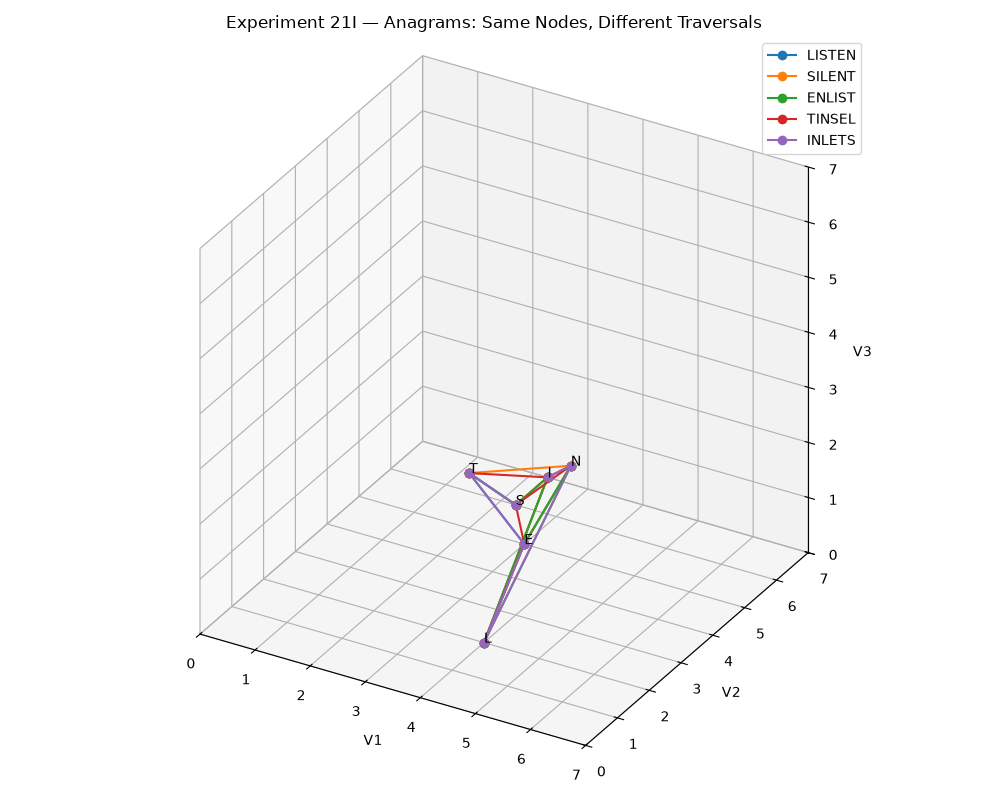
LISTEN / ENLIST: identical state occupancy, 80% directed-edge overlap, but full trajectory distance 0.667.
These are representation-specific measurements, not compatibility scores. Different paths can visit exactly the same states.
Compare LISTEN + ENLIST →Experiment 21P · 96 reference / 48 challenge words
What happens when order disappears?
Letters are deterministically converted into PCDVR states. This test preserves those states and their frequencies while changing only their order.
View the sequence test
Sequence-destruction control
Sequence carries measurable information
On an independent 48-word challenge across four word-form families, the complete ordered PCDVR trajectory classified 33 of 48 words correctly (68.8%).
Each shuffled control preserved the same PCDVR states, state counts, word lengths, and family labels; only within-word order was changed.
This result is conditional on the current curated reference and challenge vocabularies. It supports a sequence-order effect in this experiment; it does not establish universal language-origin prediction or superiority over ordinary spelling.
Experiment 21P · 2,000/2,000 replicates retained · Result fingerprint 13b5f4470b92…ccbb
Experiment 21G · 93 reference / 47 challenge words
How much of the path do we need?
Accuracy increased as the tested local windows grew from one state to four. None of those tested representations reproduced the full-path result.
The experiment compared increasingly broad local sequence context with the complete ordered trajectory.
Four-family equal-choice chance: 25%. The complete trajectory classified 33 of 47 words correctly.
Why 70.2% here, but 68.8% above?
21G uses a 47-word challenge subset; 21P uses all 48 challenge words. This is a different evaluation set, not evidence that the model improved.
The one-state local-window method is also not the same measure as 21P’s occupancy baseline. The upward sequence of accuracies does not establish that every adjacent increase is statistically significant.
This experiment isolates local versus complete sequence context inside PCDVR. It does not test whether PCDVR outperforms raw spelling.
Next: testing word boundaries →Help chart what comes next
Questions, thoughtful criticism, and support keep this independent research moving.
Support the project → Contact Bryan →